During a recent outing I heard lots of operators complain about band conditions and having trouble making contacts. I ended that day with well over 100 QSOs, so I'm offering some tips to help out new activators.
1. Use the best band for conditions that day and time. If you don't know, listen to standard FT8 frequencies on each band. If you don't hear any signals on 12m or 10m don't activate there. Similarly, if all you hear on 7.074 MHz is noise it doesn't make sense to activate on 40m either. You don't even need to set up to check bands. Log onto a WebSDR on your phone and just listen for signals.
2. Go QRO. Poor band conditions are the wrong time to try QRP. If you have a 7300 in the shack, take it with you instead of the 705. If your only rig is QRP, try more effecient modes like CW or FT8.
3. Use effecient antennas. End-fed antenna transformers can have up to 3dB of loss cutting signals in half. Try a full-size resonant quarter-wave vertical or half-wave inverted-V dipole instead.
4. For vertical antennas, consider adding a few extra radials to increase effeciency and performance.
5. Operate near water. Even fresh water can provide a good boost by acting as a reflector and may be far more useful than altitude. On HF you might be better off in a lake valley than a dry mountaintop.
6. On higher bands like 17m, 15m, and 10m hunt instead of just calling CQ. This can be more effective because skywaves on bands above 20m hit smaller circles on the Earth and reduce your audience.
7. Operate in General class band segments to maximize results. Sure, you might be an Extra and can operate in those special band segments, but it will cut your potential audience in half.
8. Get spotted. If you don't have internet in a remote park, ask your first contact to spot you.
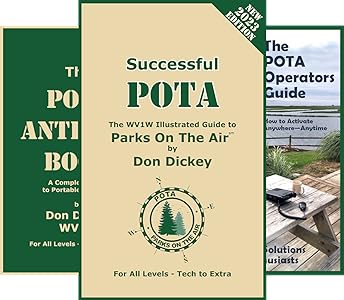
9. Read my books. After over 1,065 activations I know what works and what doesn't. The experiences I share will save you lots of time, $$$ and frustration.
73 and good luck
WV1W |